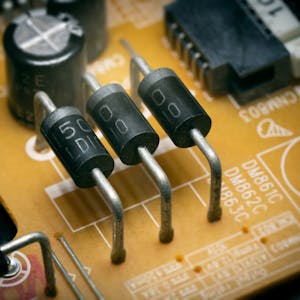
Electrical Characterization: Diodes
About this course
Course 2 begins with the definitions of resistivity and sheet resistance of semiconductors and metals and emphasizes the importance of working with the correct units for each. We see how to calculate the sheet resistance of a thin conducting film once we know its resistivity. A method to determine the contact resistance using the transfer length method is described, along with the definition of the specific contact resistivity. Current-voltage (IV) measurements of p-n junction diodes are used to extract key device parameters such as the ideality factor and series resistance. The course project explores how process monitor blocks are used to maintain manufacturing integrity.
82/100
CourseAsk score
- What the provider tells you
- 31/45
- Who stands behind it
- 35/35
- How complete the listing is
- 16/20
Scores how much the provider publishes and who stands behind it — not how well it is taught.
What you'll learn
- understand and calculate resistivity and sheet resistance
- determine contact resistance using the transfer length method
- extract key parameters from current-voltage measurements of diodes
Course objectives
- demonstrate the significance of correct unit usage in electrical measurements
- apply characterization techniques for semiconductor devices
- execute a project on maintaining manufacturing integrity
Price shown by Coursera — confirm on their site.
Enroll on CourseraYou'll be redirected to Coursera to complete enrollment.
- Listed & compared by CourseAsk
- English · 0

 Udemy
Udemy

 Coursera