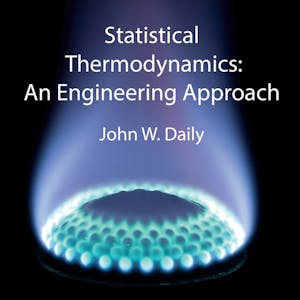
Statistical Thermodynamics
About this course
This specialization was developed for the mechanical or aerospace engineering advanced undergraduate graduate or graduate student who already has a strong background in undergraduate engineering thermodynamics and is ready to tackle the underlying fundamentals of the subject. It is designed for those entering advanced fields such as combustion, high temperature gas dynamics, environmental sciences, or materials processing, or wishes to build a background for understanding advanced experimental diagnostic techniques in these or similar fields. It covers the relationship between macroscopic and microscopic thermodynamics and derives properties for gases, liquids and solids. It also covers non-equilibrium behavior as found in kinetic theory and chemical kinetics. The main innovation is the use of the postulatory approach to introducing fundamental concepts and the very clear connection between macroscopic and microscopic thermodynamics. By introducing basic ideas using postulates, students are given a very straightforward way to think about important concepts, including entropy and temperature, ensembles and quantum mechanics.
90/100
CourseAsk score
- What the provider tells you
- 39/45
- Who stands behind it
- 35/35
- How complete the listing is
- 16/20
Scores how much the provider publishes and who stands behind it — not how well it is taught.
What you'll learn
- understanding the relationship between macroscopic and microscopic thermodynamics
- deriving properties for gases, liquids, and solids
- exploring non-equilibrium behavior in kinetic theory and chemical kinetics
Course objectives
- to provide a clear connection between fundamental thermodynamic concepts and advanced applications
- to prepare students for advanced fields in engineering and environmental science
Price shown by Coursera — confirm on their site.
Enroll on CourseraYou'll be redirected to Coursera to complete enrollment.
- Listed & compared by CourseAsk
- English · 0

 Udemy
Udemy



 Coursera



Compared on these lists
Where this course ranks against the alternatives.